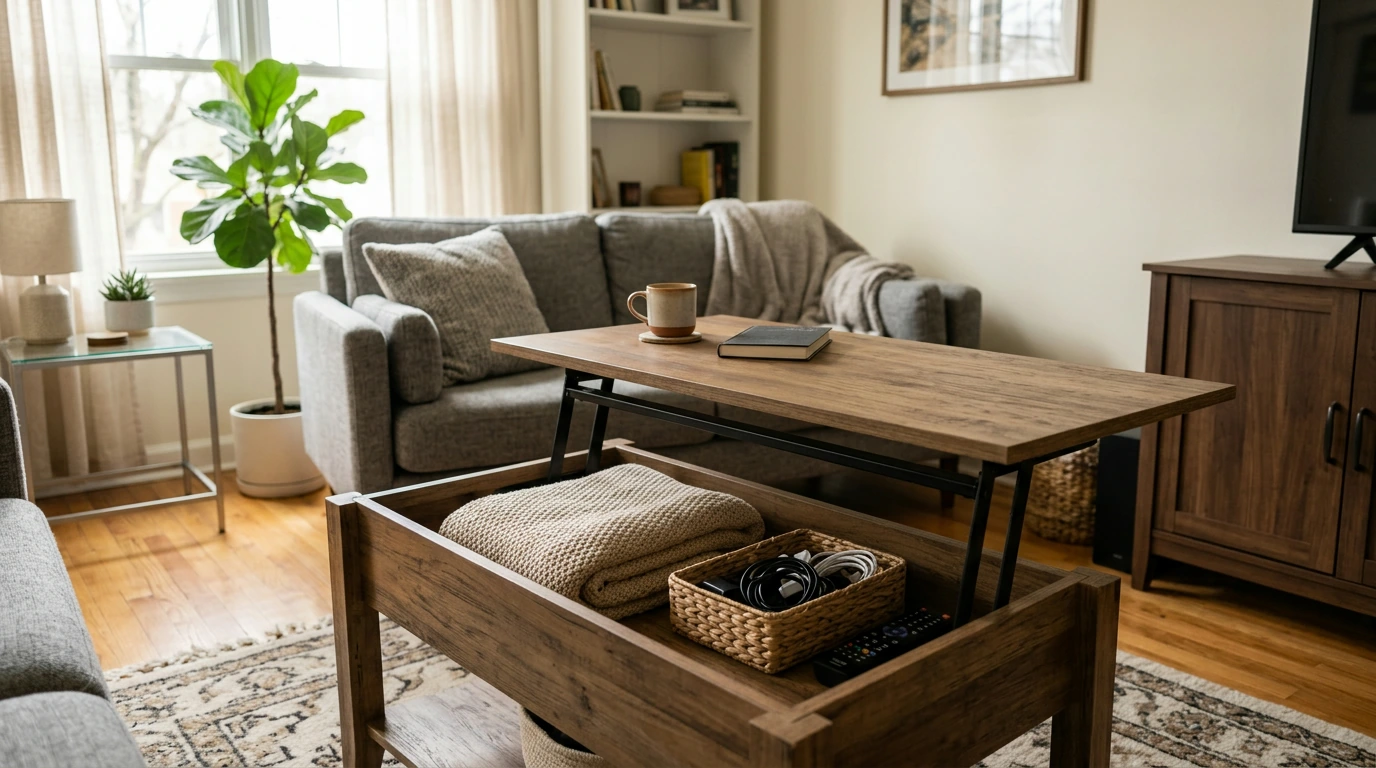
Clutter builds fastest in living areas because they do the most jobs at once—lounging, working, entertaining, and storing everyday essentials. A hidden-storage plan keeps necessities close without letting them dominate the room. Use the checklist below to spot underused space, choose storage that fits how the room is actually used, and set simple rules that keep surfaces clear. For more guidance, see Maximize Small Spaces with Smart Storage Solutions.
Before buying bins or swapping furniture, get specific about what truly belongs in the living area. This keeps storage solutions sized to reality (not wishful thinking) and prevents “extra space” from becoming a clutter magnet. For further reading, see 8 Living Room Ideas with Smart Storage Solutions for a Clutter-Free ….
| Category | Examples | Best Hidden-Storage Type | Target Location |
|---|---|---|---|
| Tech + media | Remotes, chargers, headphones, controllers | Console drawers, cable box, lidded basket | TV wall / media unit |
| Comfort | Throws, spare pillows | Storage ottoman, bench, under-sofa bins | Seating zone |
| Kids / pets | Toys, leashes, grooming items | Labeled cubes, lift-top bench, hidden cabinet | Perimeter wall / entry side |
| Paper + small items | Mail, manuals, pens | Slim drawer insert, file box inside cabinet | Near entry or desk corner |
Many “small-room” problems are really “unused-zone” problems. Start by claiming the spaces that are already there—then add storage only where it makes daily routines easier.
The most “invisible” storage is furniture that does double duty. Choose pieces that match how you move through the room: sit, charge, relax, then reset.
| Item Type | Best Container | Placement Tip |
|---|---|---|
| Cables + adapters | Zipper pouch or small bin | Store in a console drawer with one labeled pouch per device |
| Throws | Breathable basket | Keep one out, stash extras inside an ottoman or bench |
| Board games | Magazine files or shallow bins | Store vertically in a closed cabinet to prevent piles |
| Kids’ toys | Lidded bins | Use two-bin rotation: one active, one stored |
| Upgrade | Skill Level | Best For | Notes |
|---|---|---|---|
| Shelf baskets | Beginner | Blankets, extra cords | Keeps open shelving tidy with a uniform look |
| Under-sofa rolling bins | Beginner | Seasonal items | Measure clearance height first |
| Adhesive cable channels | Beginner | TV and lamp cords | Paintable options blend into walls/baseboards |
| Drawer organizers | Beginner | Remotes, pens, batteries | Prevents “junk drawer” creep |
Rentals can still feel built-in—without holes in walls. Focus on freestanding pieces and temporary systems that disappear visually once everything has a “home.” For additional small-space inspiration, browse IKEA’s small space organization ideas or room-by-room storage roundups at Apartment Therapy.
Hidden storage should be effortless—and safe. If cords overheat, shelves wobble, or lids pinch fingers, the system won’t last. For electrical best practices around power strips and cord management, review the NFPA home electrical safety guidance.
| Time Block | Task | Result |
|---|---|---|
| 0–20 min | Declutter by category | Clear view of what must be stored |
| 20–45 min | Measure and map zones | Exact dimensions for bins/furniture |
| 45–90 min | Set up hidden storage | Everything gets a defined home |
| 90–120 min | Label + reset rules | Maintenance becomes automatic |
Prioritize storage ottomans or lift-top tables, under-sofa bins, closed-door media consoles, and tall cabinets that use vertical height. Keep only one or two visible containers (like a single tray or basket) to reduce visual noise.
Use freestanding closed cabinets, over-the-door organizers, tension systems, and furniture with built-in storage. Lidded bins and decor boxes help conceal small clutter while keeping the room looking finished.
Route cords with adhesive cable channels, place power strips in a ventilated cable box, and group spare cords in labeled pouches stored in a nearby drawer. This keeps cables reachable for swaps while preventing tangles on the floor or console.












Leave a comment