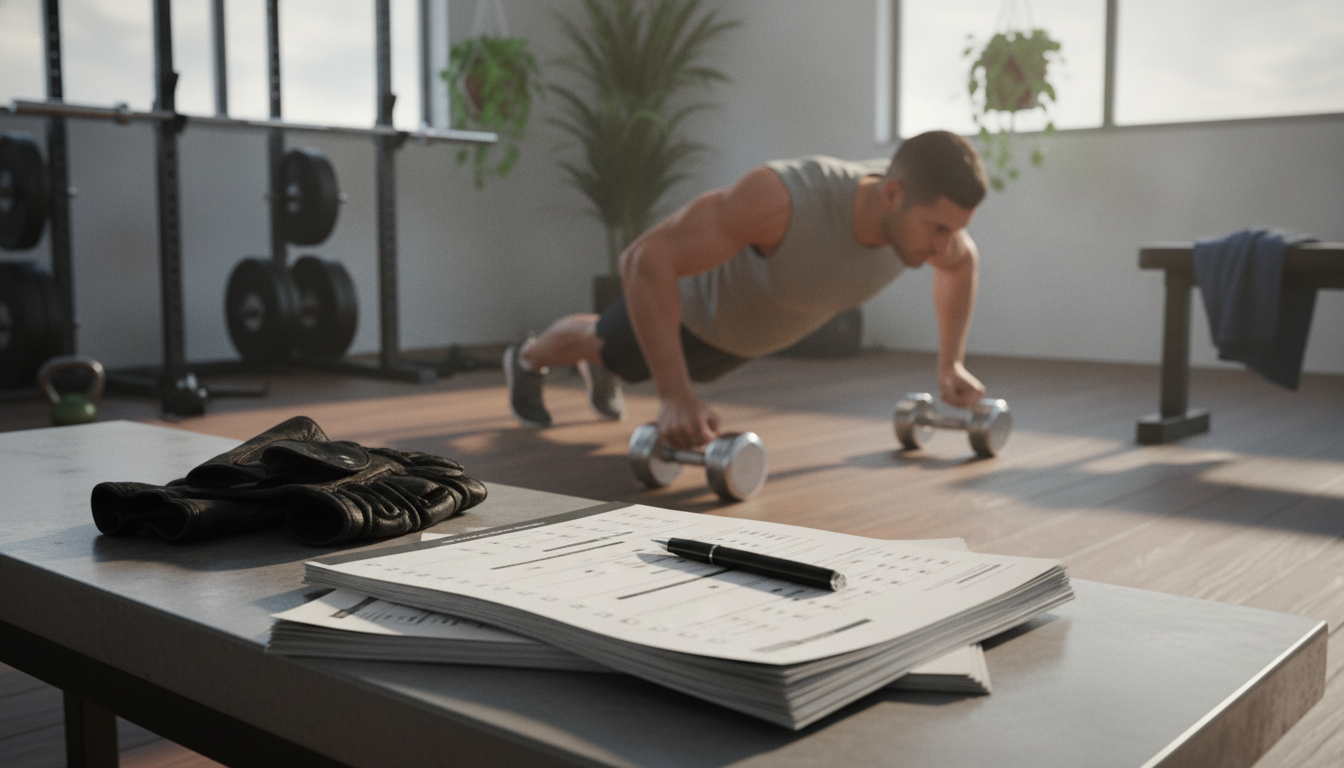
A push day can build powerful chest, shoulders, and triceps—but only when the basics stay consistent: setup, range of motion, stability, and smart progression. Use the checklist approach below to tighten pressing mechanics, reduce common irritations (shoulders/wrists/elbows), and make push workouts easier to repeat and progress week after week.
Push training includes any movement where you press weight away from your body. The big rocks are (1) horizontal pressing like bench press and push-ups, (2) vertical pressing like overhead press, and (3) pressing accessories like flies, dips, and triceps work.
The prime movers are the pectorals, anterior deltoids, and triceps. But stable pressing also depends on the upper back and serratus (for smooth shoulder blade motion), plus the core and glutes (to keep the ribcage and pelvis stacked and prevent “leaky” force).
Most push-day plateaus trace back to one of three issues: inconsistent technique, too much fatigue too soon (heavy sets pushed too hard early), or a missing range-of-motion/stability element (like unstable shoulders at the bottom or poor bracing).
The “best” push workout is the one that matches your goal and your joints. Choose a main press that you can repeat consistently, then add volume with joint-friendly accessories.
| Goal | Primary pick | Secondary pick | Accessory pick |
|---|---|---|---|
| Get stronger | Barbell bench press or overhead press (3–6 reps) | Paused press or close-grip press (5–8 reps) | Triceps extensions or dips (8–12 reps) |
| Build size | Dumbbell bench or incline press (6–12 reps) | Machine press or push-ups to near-failure (8–15 reps) | Cable fly + triceps pushdowns (10–20 reps) |
| Improve form & control | Tempo push-ups or light DB press (8–12 reps) | Single-arm landmine press (8–12 reps) | Serratus-focused work + triceps (12–20 reps) |
For evidence-based progression models and programming basics, see the ACSM position stand on resistance training progression and the NSCA education resources. For broader reading on hypertrophy research, PubMed’s resistance training and hypertrophy results are a useful starting point.
For a ready-to-use, printable system that keeps these rules in front of you during training, see Push Workout Power Checklist – Comprehensive Guide to Strengthen Your Push Movements, Build Muscle & Improve Form.
Most people do best with 1–3 push sessions per week depending on their split and recovery. A simple start is 2x/week while aiming for about 10–20 hard sets total across chest, shoulders, and triceps per week, then adjust based on soreness, performance, and joint comfort.
Start with the lift most tied to your current goal, since the first main movement gets the best performance and focus. If shoulders feel beat up, prioritize the variation that’s most comfortable, or alternate priorities across training blocks (e.g., 4–6 weeks emphasizing one lift first).
For big presses, staying about 1–3 reps in reserve helps keep technique consistent and fatigue manageable. For safer accessories like flyes and pushdowns, going closer to failure more often can work well—as long as form stays clean and joints feel good.











Leave a comment